The Big Picture: Why Physics Doesn’t Follow the Money
While the laws of physics dictate the electrons that flow to Naperville, the laws of finance dictate which power plants Naperville actually supports. Using an “interconnected lakes” analogy, this webpage clarifies the distinction between the physical flow of electricity on the grid and Naperville’s financial obligations. Understanding the difference is key to seeing how Naperville remains financially tied to coal-fired electricity through its relationship with IMEA, regardless of which power plants are located nearby.
The webpage sections are presented in the following order:
2. The Analogy of Interconnected Lakes to Represent the Electrical Grid
3. The Physical Flow of Electricity
1. Prerequisites
The following prerequisites are needed to help you understand the subsequent sections. For some readers, this may serve as a review.
IMEA
IMEA is a Joint Municipal Electric Power Agency and its own unit of local government in Illinois, separate from its Members.
IMEA is the legal entity by which the Members “jointly plan, finance, own and operate, facilities for the generation and transmission of electrical power and energy.”
The Power Sales Contracts between IMEA and each Member are full requirements contracts. The Member must purchase all of the Member’s wholesale electricity needs from IMEA. Likewise, IMEA must supply all of the Member’s needs.
In addition to the Power Sales Contracts, IMEA and Members are bound by an agency agreement, bylaws, and ordinances approved by the IMEA board of directors.
PJM and MISO
Illinois is divided between two major Regional Transmission Organizations (RTOs), PJM and MISO.
The RTOs manage the high-voltage power on the grid and the wholesale electricity markets in their territory.
IMEA operates in both PJM and MISO, because of the locations of the IMEA Members.
- 4 IMEA Members, including Naperville, are in PJM.
- The other 28 IMEA Members are in MISO.
2. The Analogy of Interconnected Lakes to Represent the Electrical Grid
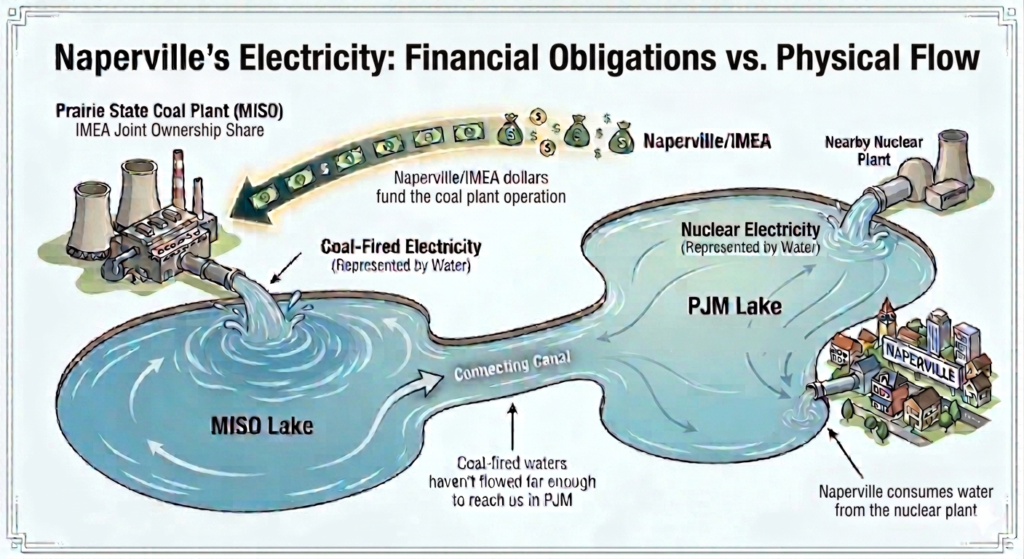
How to Read This Graphic: To understand why our Naperville ratepayer dollars don’t align with the physical electricity coming into our homes, it helps to look at the regional power grid as a shared system of interconnected lakes. While Naperville physically draws from local sources of generation, our financial pipeline connects us directly to coal-fired generation.
- Picture the shared and interconnected electrical grid as a system of interconnected lakes where water represents electricity.
- Our section of the grid has two lakes, one for PJM and one for MISO, connected by a canal so that waters can move between them.
- Generators pour water into the lakes, and electric utilities—such as Naperville—drink water from the lakes in order to distribute it to their retail customers.
- To maintain stability, the total electricity consumed must constantly match the total generated, meaning the water levels of our interconnected lakes must always remain constant.
- The laws of physics determine how the waters mix and move under the surface to maintain these levels, directing the flow from nearby plants straight to our community intake.
- But no matter where the waters flow, all the water molecules remain identical—meaning physical electricity looks exactly the same, whether it was generated by a plant with a coal stack or a plant with a nuclear cooling tower.
3. The Physical Flow of Electricity
- IMEA must supply all the wholesale electricity needs of Naperville, and Naperville must purchase all its wholesale electricity needs from IMEA.
- Naperville drinks its electricity out of the northern Illinois zone of the PJM lake.
- IMEA pours electricity into the PJM and MISO lakes using IMEA-owned and IMEA-contracted electrical generation resources.
- Other non-IMEA generators also pour electricity into the lakes, including the nearby nuclear plant and natural gas plants which are located geographically nearer to Naperville.
- Since the flow of electricity in the lakes is controlled by the laws of physics:
- The physical electricity that Naperville drinks will come from those plants located geographically nearer to Naperville.
- The physical electricity from Prairie State, Trimble County, and other IMEA resources will flow to those who are located geographically nearer to those resources.
- But no matter where the physical electricity flows, all the electricity in the lakes is still identical.
4. The Financial Obligations
- IMEA must supply all the wholesale electricity needs of Naperville, and Naperville must purchase all its wholesale electricity needs from IMEA.
- Naperville’s financial obligations to IMEA are based on the IMEA socialized costs methodology as documented in IMEA’s Rate Schedule B.
The dollars flow to IMEA when Naperville pays IMEA each month for its wholesale electricity bill from IMEA. - Those socialized costs include the IMEA ownership share of the Prairie State coal and the Trimble County coal plants. And those costs include fuel, operations and maintenance, capital costs, and debt service used to buy the ownership shares of the coal plants.
- IMEA’s financial obligations to its partners for IMEA’s ownership share of those coal plants are based on the participation agreements among the partner owners. The costs include fuel, operations and maintenance, and capital costs.
- Dollars flow from IMEA to the management companies of the plants that were formed by the partners to operate the plants.
- Roughly 35% of IMEA dollars come from Naperville’s share of IMEA’s socialized costs, and those dollars come from Naperville ratepayers through their monthly electric bills from Naperville.
- Because of the full requirements contract and the socialized costs methodology of IMEA, Naperville cannot stop paying for the coal-fired portion of the IMEA resources mix without changing its relationship with IMEA.
5. Conclusion
When considering only the physics of the grid, it is “strictly correct” to state that Naperville “physically” receives its electricity from nearby plants
However, that physical flow of electricity is irrelevant to the financial obligations and ties of Naperville to the electricity generated by the IMEA resources.
- IMEA and the IMEA board members, including Naperville, have chosen for IMEA to own shares of the Prairie State and the Trimble County coal plants.
- Those coal-fired generation resources are used to satisfy the full requirements commitments between IMEA and the Members, including Naperville.
- Naperville ratepayers pay for our Naperville share of those IMEA resources, and not the nearby plants that are not IMEA resources.